
Instructional Designing

Importance of Infographics in Marketing

Do you make use of Infographics in Marketing?

Use of infographics in marketing in very common these days. image shows some infographic elements and shapes.In this age of big data, the entire gamut of digital marketing has shifted towards processing data and information. In such an environment, it is almost binding that the presentation of data be in a lucid format that allows users to analyze and arrive at a certain decision about a product, service or trend. So, putting your data represented in an infographic form is one of the game-changing aspects that may usher in unprecedented returns for your investments.

What is an Infographic?

An Infographic is the graphical representation of a data or set of data. An Infographic data form basically repaints mundane or at times, complex information in a manner that gets a trending response from its subscribers. An infographic that explains the steps for online shopping.

Why an Infographic?

It is often noticed that complex piece of information such as metrics or comparison of trends over years, geographies or among competitors in plain numeric or textual form, is usually hard to analyze. Plain depiction of tabular data often poses a cognitive barrier between the information and the user.

While on the other hand, the same data when arranged in forms of graphs and charts, becomes highly convenient for audience to not only understand and analyze but to also use it further. This simple phenomenon makes Infographics very useful resource for your business.

Does it help to use Infographics in marketing? 

Just like the company logo or other branding material, Infographics help you develop that special connect with your customers. Once they like your campaigns that use memorable illustrations, the brand recall improves considerably and your potential customers are likelier to remember you at the right time.

How to develop a good Infographic?

Designing a good infographic, first of all, requires a deep understanding of the company’s business: products, services, customers and target base. This determines the information that needs to be presented for everyone’s consumption. It is necessary to ensure that it does not go against the business ethics or is not debatable.

The next step towards developing attractive infographics is to acquire an expert graphic designer who can visualize and translate this data into visually appealing creatives that can attract maximum attention once shared across various platforms.

Who can develop a good Infographic for you?

While the idea of developing an Infographic might sound simple, yet you should know that it requires sophistication and a certain skill set. Remember that a poor design may bring more of harm than utility to your brand.

Of course, the best infographic content will come from your business development team itself. However, it might serve better to get fresh ideas from an agency. So, it is wiser to hire a creative agency with proper credentials as well ensure that the team members on board are mature enough to understand your business dynamics.

Ascezen Consulting is one such agency that can deliver quality infographics within the budget constraints.

Why Ascezen?

The team behind Ascezen Consulting Pvt. Ltd. carries vast industry experience. The talent that has been delivering for some of the most prominent brands in IT, Retail and Hospitality sectors will now be focused to create value for your brand, while putting latest tools and best practices available at your disposal.

 

Read more...

Use Short Videos to Promote your Business

We have come a long way when it comes to using ways to promote a business. It used to be billboards, magazines or Picture of a collage showing video clip icons, and movie-cameranewspapers a lot time ago. Today, the best way to attract and engage the customers could begin with a short video to promote your business by leaving an impressive message, quickly. Use of short videos to promote your business can get magical results for you.

Use of short videos for advertising picked up with Television ads when we could see people getting hooked on to get the message that was dying to reach them through other media. Whether it is an elevator pitch or a sales pitch, any message can be beautifully delivered through a video with catchy phrases, punch lines, colorful fonts, impressionable imagery, and a dialogue form.

In the initial days of television advertising, people tried to avoid the ads by lowering the volume but today, most people enjoy watching them. With popularity of new media and the booming young population using them, videos have become a powerful tool of communication. A sample video can be seen below.

The video inserted above talks about the business writing services offered by Ascezen Consulting. There can be videos talking about how to use a product or a tool. You can create one for anything you would like to demonstrate or use in training. This one has been created using a pretty simple video creation tool but there is good deal of thinking, planning, and design work before you get that short video to say it all.

It is challenging indeed to keep your message short enough to be covered in a video. As an entrepreneur, you might have volumes to say about the products or services you offer but your audience has limited time. You can’t have their full attention for more than 2-3 minutes. An instructional design professional or an e-learning developer knows the finer points of creating an appealing and effective video.

At Ascezen Consulting, we are capable of creating short videos such as the one above that we did for ourselves. Drop a line to know more about the type of videos we can do for you.

Read more...

Top 5 Reasons Why Should You Invest in a Content Vendor?

Top 5 Reasons Why Should You Invest in a Content Vendor?

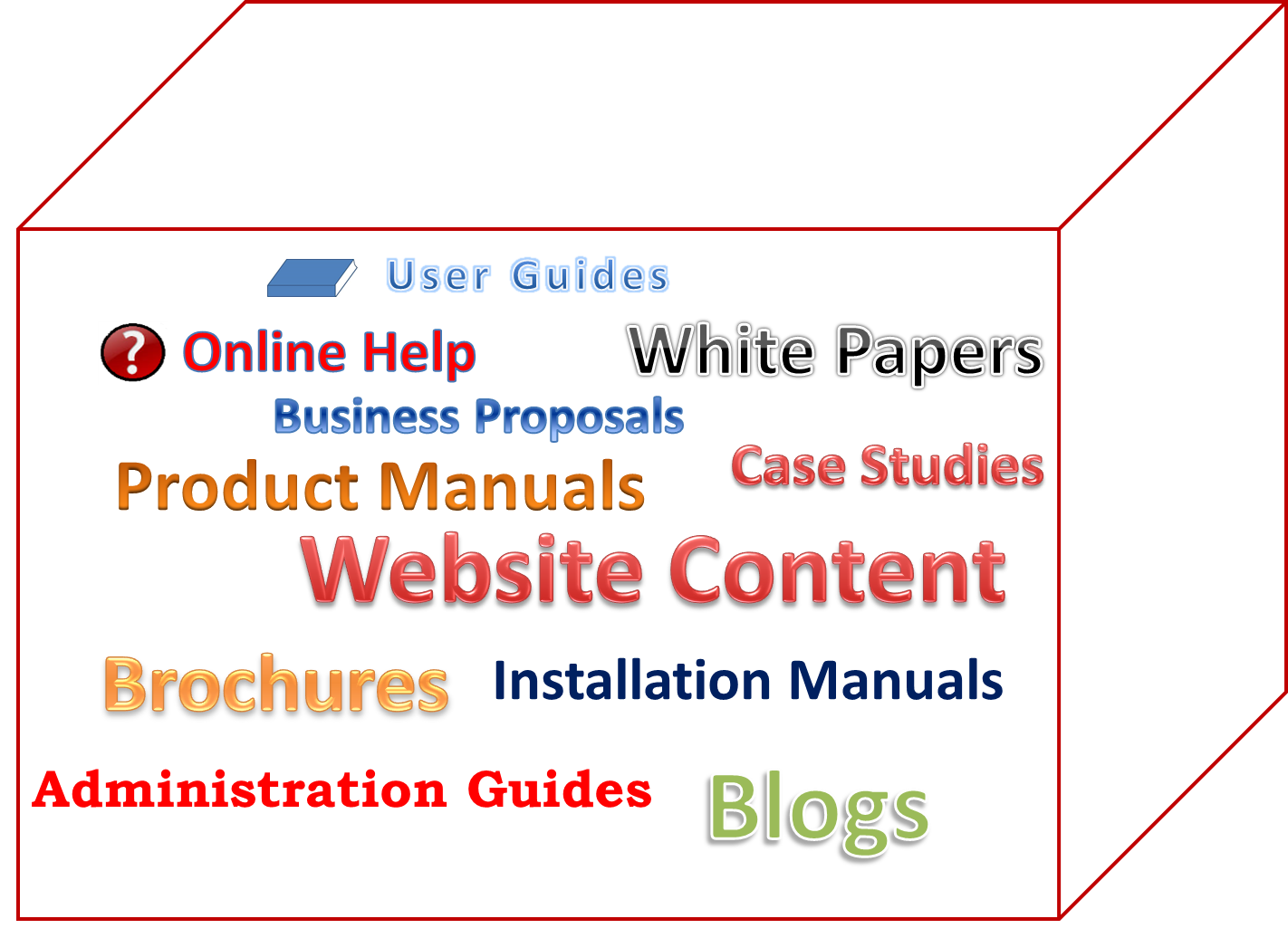
Image showing a box containing the names of content outputs and work products.In the present business scenario, there are quite a few companies who have a content team or technical publications department in place. They are the ones who understand the value of having content creation or documentation expertise in-house. There are other companies who either don’t have the budget or a permanent need to employ a team of writers and obviously some managers to look after them. Most of such companies rely on freelancers or contractors when they have a content requirement such as refurbishing their website or blog, and may be when a product needs documentation just before shipping it out. Many people would agree that there are challenges in working with freelancers. Here are top five reasons why organizations should seriously consider investing in a specialist content vendor or content service provider.

1. Using A Specialist On The Job Is Always Better

It is always safer to have a specialist do the job. Though it seems anyone with good language skills can produce any kind of content but let’s admit that it is just a myth. Even within the range of content, there is whole lot of variety to be dealt with and there are specialists in handling technical content, business content, web content or something for print media.

Besides, there are some search engine (read google) trends to be followed at a given time, differences in writing styles across geographies and industries. An experienced writing professional would be able to add greater value from all the significant perspectives.

2. An Established Content Services Provider Is More Reliable Than A Freelancer

If a content vendor is a registered company then its reliability quotient is much higher than a freelancer sitting in a remote place, a few continents away. While it is possible for a freelancer to vanish and return with a brand-new profile and persona, it is not so easy for a company that has to create a name for itself and grow its business in the long term.

A content vendor would be more likely to have a business continuity plan and adequate resources to deliver in time even in case of materialization of some risks.

 3. A Content Vendor Can Give More Variety Than A Freelancer

A content service provider would be able to provide a great deal of variety in content solutions ranging from website content, blogs, brochures, case studies to user manuals, online help and training videos or e-learning solutions. A team of independent contractors or freelancers may be able to produce all of this but it would be a herculean task to coordinate and get consistent results in quality as well as timelines.

4. A Content Vendor Assumes More Accountability And Shares The Risks

Some organizations, owing to their domain and industry segment, might often be under the threat of facing legal consequences due to copyright or plagiarism issues. It is imperative to review their content for originality before it is published or circulated. Service-level agreements are one of the means of ensuring that the authors take some responsibility but a vendor company is far better risk-sharing partner than an individual. Besides, a content vendor may employ better means to check plagiarism such as a peer-review process or using plagiarism detection tools.

5. A Content Vendor Saves Management And Quality Assurance Costs On Content Production

Managing a team of freelancers also has a cost. More than the cost factor, it is the ability to judge the quality, originality and cost of content production that needs a relatively much experienced professional with content or documentation expertise.  A freelance writer is self-managed but a team of contractors would need a manager. A content services provider, on the contrary, would be able to provide an expert supervision and project management at a comparable much lower cost than a full-time manager to manage a need-based engagement with freelancers.

Read more...

How to Create Learning Objectives

To create SMART learning objectives, you must consider the following rules:

Learning objectives come in the form of statements and contain a Verb (an action) and an object (usually a noun) in each statement.

  • The verb is a reference to the actions associated with the anticipated cognitive process.
  • The object (usually a noun) depicts the behavior, attitude, or knowledge expected to be acquired by and exhibited from the learner after the learning session.

The steps for creating effective learning objectives are as follows:

Create a Stem: Learning objectives must be made with a stem that shows the end result of the program. It gives a clear picture of the outcome of the learning process. You can use any of the examples while creating a stem.

  • After the workshop, seminar, training session or a class the learner will be able to…
  • After finishing this activity, the learner will have…
  • After the completion of this part of study or training, the student or learner will…
  • On the conclusion of the unit/course/session/study, the learner or a student will…

For example: The learner will be able to speak with confidence on any topic.
OR
The learner will list the steps involved in the process of creating a business report.

Add a Verb: After creating a stem you need to add a verb. It will show the observable action, which learner should be able to do. The following table shows the various verbs associated with the action or outcome intended and expected from the learner. 

  • If you want the learner to exhibit knowledge after going through the instructions and learning, use the following verbs in the learning objectives you devise.

Verbs used in learning objectives to exhibit knowledge

  • To gauge the understanding of the concepts, you can test the ability or knowledge of learners by using the following verbs in learning:

Verbs used in learning objectives to demonstrate the understanding of concepts

  • To know the capability of the learner to apply the knowledge imparted under the learning program, you can use the following verbs in your learning objectives.

Verbs used in learning objectives to demonstrate theapplication of knowledge

  • You can also check the ability of the learners to analyze or evaluate by using the following verbs.

Verbs used in learning objectives to analyse or evaluate

  • You can also test the ability of the learner to synthesize or to create by using any of the following verbs.

Verbs used in learning objectives to synthesize information

  • As an instructor, guide or a teacher you would want to know whether the learners or students are able to evaluate and assess the concepts or ideas. For this, you can use the following verbs in your learning objectives.

Verbs used in learning objectives to evaluate and assess the learning

In the process of planning the learning objectives, you can follow some of the following points for better results.

  1. Commence with an action which is observable and measurable.
  2. Do not use words that are ambiguous or open to different readings.
  3. When required, you must state the criterion or expected standard of performance.
  4. Try to keep in mind the intellect of the learners at the time of starting. Then you can devise the learning objectives which will take them to the next level.
  5. Ensure to include all the major concepts or points when you are creating the learning objectives.

In a nutshell, to achieve the desired result from a training or e-learning course, you need to have the objectives clearly defined. Creation of learning objectives, hence, serves the purpose for all its participants and makes the learning process more enriching, inspiring, and successful.

Also Read: Learning Objectives: Commencing with End in Mind

Read more...

Learning Objectives: Commencing with End in Mind

Learning ought to be a continuous process to stay up with the latest trends. It is not only restricted to the academic lot but includes all who wish to grow. Learning can be in the form of classroom learning, e-learning, by way of actually doing it. No matter what method of learning it is, it will always come with an objective that must be achieved at the end of it. A learning objective is a statement of expected results from a learning session or training module. It can take the form of a list enumerating what the learner is expected to achieve or accomplish after undergoing the learning module.

Learning objectives must be written clearly in the form of learning outcomes. Moreover, these objectives must be measurable or quantifiable. They must aim to elicit the desired behavior from the learner and also help the instructor to make sure that learning took place as planned. No organization would spend money on a learning program that fails to achieve the learning objectives and serves no purpose. Planning of learning objectives can help the organization reap various benefits, as discussed below.

 Advantages of Learning Objectives

  • Learning objectives help in focusing on focus learning areas for better performance.
  • These objectives aid the course developers and trainers in course planning and organizing a course into logical modules.
  • Learning objectives help the instructors to customize the learning material as per the requirement.
  • They allow establishing a relation between the content and the assessments, according to the learning theories.
  • They make learners aware about the course they will go through and what is expected from them upon its completion.
  • They eventually serve as a basis for appraising the performance of not only the learner but also of the instructor or the effectiveness of the learning program.

The above-mentioned advantages clearly emphasize on the need of having the learning objectives in place, with utmost attention and prudence. Therefore, while planning, it must be ensured that the objectives qualify on SMART parameters. SMART is an acronym that stands for:

  • Specific
  • Measurable
  • Attainable
  • Realistic
  • Time Bound

Setting SMART learning objectives will make the training or learning modules more effective, practical, and relevant. It is noteworthy that straying away from the clearly-written learning objectives may render your learning efforts a futile exercise.

Learning Theories

There are various theories used for creation of effective learning objectives. Some of commonly known theories include the Bloom’s Taxonomy, Simpson’s Taxonomy of the Psychomotor Domain and Harrow’s Taxonomy of Psychomotor Domain. Among these, Bloom’s Taxonomy is widely used to create effective learning objectives. Developed by Benjamin S. Bloom, the theory covers three domains which are to be followed during the learning program. The categories covered are as follows:

  • Cognitive Domain (intellectual competence i.e. knowledge)
  • Affective Domain (behaviour,  feelings, attitude)
  • Psychomotor Domain (physical or manual set of skills)

The domains are explained as:

  1. Cognitive Domain: Under cognitive category, Bloom has divided it into six stages covering lowest to highest form of cognitive learning. The six levels covered under it are as follows.
    • Knowledge: It involves understanding, memorizing, or simply recalling information shared by the facilitators or instructors.
    • Comprehension: This stage is characterized by profound understanding of the concepts, ideas or information imparted by the trainer, instructor, or a facilitator. The learner—after proper grasp of the concepts—is able to come up with the theories in his own words.
    • Application: In this level, the learner is able to put his knowledge to practical use. It involves practical application of the knowledge
    • Analysis: This level lands the learner into analysis mode where he breaks down the information and concepts learnt in the previous stages. He is able to analyze and draw logical conclusions.
    • Synthesis: In this phase, on the basis of the learning process, the learner is able to combine the pieces of knowledge, ideas, and information in a coherent manner. He is equipped to come up with his own set of innovations and creative ideas on various topics.Evaluation: At this stage, both the learners and instructors can easily evaluate and appraise the performance. Critical feedback is an important component in the entire process for improving the end result.
  2. Affective Domain: It is a vital factor in the theory of Bloom’s Taxonomy. This domain relates to the emotional well-being of the learner. It takes into account the feelings, emotions and attitudes of the learners. It aims to boost confidence and self-esteem of the learner.
  3. Psychomotor Domain: This category includes physical well-being of the learner to ensure active participation. It focuses on the use of one’s own hands or equipment to find the answers or solutions.

Of all the above mentioned domains, it is primarily the cognitive domain that is considered while formulating learning objectives. You can use Bloom’s Taxonomy to make the learning process more comprehensive and the result of it more wholesome.

Also Read: How to Create Learning Objectives

Read more...

What is Instructional Designing?

Instructional Designing is an art of creating sets of instructions that make it easier to upgrade knowledge and skills in any area of study or work Instructiondiscipline. Any course of study or a training module needs a systematic approach in its development, which is governed by some principles of instructional design. The course developers need to have the objectives and expected end results clearly documented in a well-written document. Not just that, they need to plan what needs to be done to achieve the objectives, identify the milestone deliverable  visualize about the building blocks after understanding the requirements and last but not the least, ensure a meticulous adherence and implementation of the planning.

The most relevant application of instructional designing can be seen in imparting education. There have been continuous advancements in the ever-evolving education systems around the world. The focus is shifting to methods of experiential learning or learning-by-doing from the traditional lecture based teaching or rote learning. This evolution started with the revelation about the many forms human learning such as visual, auditory and kinesthetic (through experience).

Another radical change that has affected the teaching or learning methodologies is the advent of computers and Internet and, leading to options of distance learning. The idea of learning from a remote location opens up many challenges such non-overlapping availability of learners and instructors, communication barriers due to physical absence, delay in responses or feedback and so on. All this points to need of course material that engages more, reinforces the learning, asks questions and gives instant feedback for assessment. Getting all this together couldn’t have been made possible without a well-thought method to weave the courseware with seamless sections and logical breaks. Enter the world of instructional design where learning happens with an instructor who talks less, who may be present only virtually and in some cases, not even required.

There are different models of instructional designing. Most of them generally comprise of five phases. The first phase is analysis, where the designers study the requirements or expectations from a learning module or product. Next comes the design phase which deals with translating the spoken or written requirements into a developer’s language with minute details of how the product will come into being.  The development phase starts when the design is ready, followed by implementation and evaluation phases. The entire learning development cycle is executed by a team of instructional designers, graphic artists and software programmers, in a streamlined manner, using defined processes.

Read more...